
This post was originally published on this site.
There are some areas of mining technology where China is some distance ahead of the rest of the world today – and remote control, or teleremote, operation of mining excavators and shovels is certainly one of them.
The major Western excavator OEM players – Komatsu, Caterpillar, Hitachi Construction Machinery (soon to be Landcros) and Liebherr all have active programs in place and have carried out some trials. And there are third party tech companies – such as Hexagon with its TeleOp solution acquired with its HARD-LINE acquisition, and RCT Global (part of Epiroc) with its ControlMaster® Teleremote, to name two examples, that have had some successful installations.
But on the whole, teleremote operation outside of China has moved forward more rapidly for dozers – this is partly because the safety issues with dozer operations, especially in waste dumps and tailings, or unstable mining areas, are more stark; and partly because the feeling is still that in an excavator, a human operator in the cab is more productive, due to teleremote systems having perceived issues with depth perception, visibility in poor weather and night conditions, plus a lack of real feel when it comes to weight of material in the bucket, for example.
Added to that, for mines with AHS fleets, the excavator operator still retains a central role in systems like Command for hauling and FrontRunner in managing the autonomous loading area by bringing trucks in and kicking them out. But fundamentally, the major mining houses are just no yet convinced of the technology’s productivity or economic upside – at the end of the day it isn’t full autonomy so it isn’t saving on manpower – plus even if it was fully automated, it wouldn’t be saving dozens or hundreds or truck operator salaries.
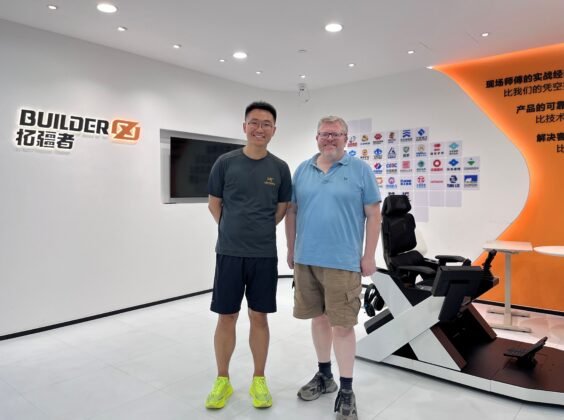
BuilderX CEO and Founder Shaolong Sui with IM Editorial Director Paul Moore at its HQ in Beijing
IM Editorial Director Paul Moore recently travelled to Beijing to meet with the market leader in China, BuilderX, in its main offices and development lab. CEO and Founder Shaolong Sui has a classic Silicon Valley background – a Stanford graduate, with various technology roles within Tesla, Apple and NVIDIA, before returning to China to set up educational robotics company ROBOTERRA in 2015 and then Builder X Robotics in 2018, which rapidly found its feet in mining and construction, but also other industries such as port terminal operations.
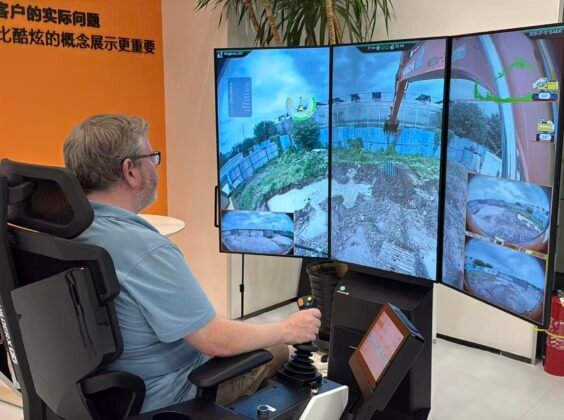
IM has been following the company closely since 2020 when it applied its solution to XCMG’s 93 t class Intelligent Hydraulic Excavator, the XE950DA which began successful teleremote operations with Jiangxi Copper Group. Today, Builder X has over 300 systems running, the vast majority of which are in China and in mining – most on hydraulic excavators, but many on electric rope shovels as well. These systems now have well over 100,000 operating hours, with retrofit installation in as little as 1.5 days. The system mounts multiple HD cameras, proximity sensors, and spatial detection modules (like LiDAR) onto the machine. This hardware works in tandem to provide a 360-degree clear view with no blind spots. The operator operates the machine from a dedicated tele-console. The feedback can use any type of reliable connectivity including 4G, 5G, Starlink, mesh Wi-Fi, fibre, and private wireless networks.
Most of the 300+ sytems are in Xinjiang or Inner Mongolia – with excavators dominating in Xinjiang as the coal industry there is more recently developed with almost exclusively smaller class wide body trucks well suited to smaller loading tools. Inner Mongolia remains dominated by older mines with larger rigid mining trucks and large payload electric shovels. Another reasons is that Xinjiang mining is dominated by contractors, whereas Inner Mongolia also has many owner-operator fleets. Contractors want more flexible and nimble fleets that they can move from one site to another – so wide body trucks and associated loading tools fit well with their needs. It is also a question of cost – the contractor market is highly competitive and based on mined volumes, so smaller hydraulic machines have a much lower initial cost. It is not the only system being used in China – AHS major CiDi for example is an important competitor, especially in Xinjiang, with its Meta Cockpit and Tele-Block Systems, but BuilderX has by far the largest installed base and most operational hours.
The intelligent mine growth in these regions is no accident – these areas are where China’s largest mining fleets are running, especially in coal – and where the real state and national government push towards intelligent and green mining has taken and is taking place. These include the Guidelines for High-Quality Development of Open-Pit Coal Mines issued by the China National Coal Association that aims at 80% of open-pit coal mining capacity achieving ‘intelligentisation’ by 2030. In 2024, the National Mine Safety Administration and the National Development and Reform Commission jointly issued the ‘Guiding Opinions on Deeply Promoting the Intelligent Construction of Mines and Promoting the Safe Development of Mines’ calling for the establishment of a comprehensive intelligent mining standards system with the goal that by 2026, intelligent coal mine working faces will account for no less than 30%, and the regular autonomous operation rate of coal mine working faces will reach no less than 80%. Xinjiang and Inner Mongolia as provinces have also laid out demonstration areas for autonomous mining trucks to promote their large-scale application in the industry.
This regulatory push towards autonomous mining and diesel free fleets is a major reason for China’s leadership in these areas – and while early on some mines just ran pilots, demos and test projects to tick the boxes that they had active projects – there was also a rapid realisation that this technology actually worked and had a huge efficiency upside as well – today taking one company alone, EACON now has over 3,700 mining trucks automated and counting, with over 160 million kilometres driven. So the boom in teleremote excavator operation is also part of this same trend.
Sui: “The two market drivers are safety and policy, but the two are linked because safety is also part of the policy push. There is a push for intelligent and safer mining in both regions, but there is another factor in that the government understandably wants the state-owned mining companies to set an example and be first technology adopters.”
With its first major mining deployments in 2020 – are there any fundamental improvements that Builder X has made in terms of functionality or learnings it has taken on board from what is now nearly six years of continuous teleremote systems operation? What has been added beyond basic remote control?
“I would highlight three things as being very important, that I would say came in stages. First, when we began introducing teleoperation in mining in China, initial users complained about a lack of depth perception for the operator as well as a lack of real feedback from the controls. We managed to work through these using some operator assistance functions and give them a better feeling of the surroundings and of the machine itself. And in some cases we have been able to go further and strengthen or enhance their perception. For example, mining operations in the summer in these regions are often very dusty to the point that working on site, there is so much dust that the operator can barely see anything. But sitting in the office through our sensor-based operator assistance tools and the screen experience, they can see much more clearly than in the real cab.” This is achieved using the Dust See Through tool, which enhances visibility by overlaying an AI-enhanced clearer working view.
What about not being able to feel the weight of the bucket and the forces on the machine during digging, for example? can feel the forces or you can feel the weight of the material in the bucket. “This is a difficult thing to translate into technical terms? Modern excavators have an electrical hand joystick. So, they don’t transform any force back to you? The feeling operators get is most based on brain expectation. From our experience, after operators get used to operating the excavator from an office, they quickly used to it.”
Sui said another solution for improved perception terms is a topography profile scan, allowing the operator to ‘see’ how significant in relative terms a stockpile or muckpile; or to get a better idea of the height of the high wall or the gradient of the slope in front of them. This Topographic Profile Scanning tool uses a combination of LiDAR with AI. Other tools include Attitude Monitoring, which shows the tilt and roll angle of the mining equipment in real time with accuracy up to ±0.1°; plus Pedestrian Detection, which uses AI algorithms to detect pedestrians and alert the remote operator through a pop-up window. The Bucket Depth Indicator offers real-time bucket position tracking supporting precise landing, excavation, loading, and dumping.
IM getting some BuilderX system experience
The second main stage of product development BuilderX went through was to make the system more reliable in terms of the sensors on the machine itself. “We did a lot of vibration tests, as well as high and low temperature, plus wear resistance – because some of these types of sensors at that time had never been proven in outdoor harsh mining environments outside before, they had mainly been used in factories and indoor plant environments. So we did a lot of work on customising existing sensors, along with our own design work, plus looking at how they are mounted, to make sure they could stand up to the mining environment – especially vibration and shock. And it was a learning process – for example we found that the forces were higher on these sensors deployed on dozers than they were for excavators.”
Finally, Sui said a third stage was more recent – that that was to lower potential barriers for the customer – lowering cost where possible, plus things like making the system easier to install and refrofit, easier to troubleshoot problems and better post sales servicing. Some of this is quite complicated system level work. “For example, once you see your screen turn black, what’s the reason behind it? It could that the main camera was broken by a flying rock. Or the connecting wires were by mistake Or there was a WiFi outage, or simply the screen burned out. Before, we had to send our engineers on site to investigate which took a long time and cost as these mines are in remote areas. So, in 2025, we upgraded our system to make it more modular so when something malfunctions, our panel will give you an error code and even tell you which part needs to be replaced. We have gotten to a speed of resolution of as little as 15 minutes in some cases. So once people say, wow, the screen turns black, then he or she can check on the touch panel and see the error code.”
Another push to get this right was the sheer uptick in demand, especially from existing customers who opt to retrofit additional machines. “Typically, mines will buy one system, and then after they use it for six months to year, they see the productivity and safety benefit so they move to buying another four or five to cover their main excavator fleet. Today, our repurchase rate is higher than 80%. So these troubleshooting improvements allows us to show our customers that it is a very reliable tool which is practical and robust enough for long time use in a harsh environment – but if there is an issue it will be easy to resolve.”
Sui added that actually the most common cause of failure is a lack of WiFi network. “When they set up a 5G private network, it covers everywhere and does it very well – but these huge coal mines especially are digging very quickly, so the mining fronts are changing its shape all the time. At the beginning, a 5G station might cover a corner well, but two months later, material has piled up into a heel structure meaning in certain areas, there is a signal blind spot even though it might be temporary as production moves on.”
BuilderX has been able to design new algorithms to make sure that even though there is a blind spot or very weak signal, teleremote operators can at least continue to work temporarily by which time the signal issue is often resolved.
Another interesting evolution is that some locations are also using one urban office location to control equipment at more than one minesite – in the past the vast majority of cases involved a control centre for one mine located on that site. “Today we have examples where one control room with teleremote excavator systems for two mines that are both as much as 50 km away. In addition, our system makes it relatively easy to switch between different machines at the same operator station – so they can change which excavator they are remotely operating based on the required tasks for that shift.”
Have the mines in China using BuilderX system typically installed autonomous haulage first? Sui: “Actually because the initial driver is often policy linked, the remote control excavation and autonomous haulage are normally installed around the same time – especially in Inner Mongolia and Xinjiang.”
BuilderX also has good relationships with the key AHS providers and has worked together with EACON, the market leader, on many projects, but also with other key AHS players. “So sometimes we work with them directly and we will showcase our solutions directly to the customer. In other cases like, we go into a project on our own – and in fact many of our installations are in mines with no autonomous trucks, with the requirement based on the shovel or excavator working in a hazardous position or environment.”
What about the excavator OEMs? Are they promoting the BuilderX solution as a technology enhancement or add on? The first installation at Jiangxi Copper was on an XCMG machine, for example. “Sometimes for new machines deliveries, the OEMs will offer it as part of a solution to the customer and involve us as their supplier; some OEMs are actively seeking collaboration with BuilderX, including XCMG, LiuGong and XGMA in China. In Japan, Sumitomo Construction Machinery also officially offers the BuilderX teleoperation system as part of its product portfolio. In any case, the majority of our work is on retrofits of excavators already operating.”
BuilderX technology is running on excavators in China across most of the major OEMs including XCMG, LiuGong, Sany, plus TYHI on rope shovels; but also Western brands like Caterpillar, Hitachi, Liebherr, Volvo and Komatsu – and there many units of these brands running in China, more so than for mining trucks, as they are still seen as offering better reliability and performance over the long term.
Another part of the market is working through partners, agencies and dealerships, especially overseas. In Japan, for example, Sumitomo is the exclusive importer and distributor of BuilderX’s product for the Japanese market and this partnership has been highly successful, though is mainly focused on the construction market. In other markets, BuilderX is in the process of establishing other partnerships with companies in Chile, Indonesia, Brazil, Australia, Mongolia and Malaysia, for example. And it has already begun expanding in Europe through a collaboration with PJC Machinery in Poland (see detailed section below). The potential is huge overseas, partly as the technology from other sources whether OEMs or third parties is not as advanced or proven yet as that from BuilderX. But the demand is there – ageing workforces, young people not wanting to work at remote sites, strong focus on safety – these are all factors. The thousands of hours that BuilderX has of real operations, and how this has been translated into improving the operator experience, plus its already discussed solutions for the robustness of its system in challenging conditions, give it a current advantage.
Sui gave an example of the level of detail this experience has involved. “During the winter, a customer called saying the camera image was blurred. We did not believe water could get into our cameras because we had designed it that way – not even vapour, as the cameras operate with a special gas inside to avoid this. We checked with some camera experts who said that the reason might be that the lens and the lens barrel are injection moulded with different material; and when it’s super cold, their heat expansion ratio is different. This turned out to be the case, so now we use the same materials for both. So it isn’t always about algorithms – we know about a lot of the potential problems because we have faced them by the fact we have deployed so many sets in real mines.”
Sui adds: “We have only been able to work through these practical problems by deploying so many sets in harsh mining applications for many years, so this is an entry barrier for other companies trying to succeed in this teleremote excavator market, as they have not been through these multiple iterations.”
He continued: “We have seen a change in the past two to three years – before mining companies were very sceptical that 24/7 production teleremote excavation could achieve parity in performance. But today when they see what we have achieved there is much more interest and confidence. We went through the same thing in China in 2020.”
Today in China, BuilderX says it has more than 80% of the market share in this niche – generally if they require the technology and they have the budget they will select BuilderX because of its track record. “They can come to our HQ, try out the technology and voice any concerns. A common question is what does the latency look like? When they try it out for themselves they can see that some variation between 140 or 200 milliseconds is really not that important from the human operator point of view as the operator will not really perceive it.”
What are the differences between the rope shovel system and the hydraulic excavator example? Sui: “At one level it’s a universal control, but the different machines still have different ways of controlling things, which from our side we can control with software that allows use of the same joysticks but they work in different ways with different movements under different machine modes. For example, operation of a rope shovel is relatively similar to a hydraulic face shovel, whereas the backhoe hydraulic excavator is somewhat different. However, we also need to make allowances for machine sizes and the different payloads – so the control algorithms make sure the movements change accordingly.”
In terms of system deployments in mining, the majority today are controlling backhoe hydraulic excavators, followed by rope shovels, with the smallest number on hydraulic face shovels. Beyond mining, other major markets include port clean up, recycling, forestry and dredging.
One major advantage of the BuilderX system is that you can put the cameras anywhere you want, and you can adjust the system views as you want. This means expert operators can have a say in what works best for them. A good example of the upside in this is with dozers. OEM-led teleremote systems make it quite hard for dozer operators in a dozer push application on the edge of a steep waste pile drop off to ‘see’ in front of the dozer – with better camera positioning, they can move the material with more confidence because their perception is better. While to a non operator eye the view selection might seem strange in some cases, they know what is best for real intuitive operation. BuilderX calls this operator led innovation. Another example from open pit mines is where operators have requested an additional camera on the excavator boom, so they can see what is already inside the truck they are loading, such as are they achieving an even distribution.
One of the reasons BuilderX can do this is again because of its iteration experience – today all the ancillary cameras are magnetic, these are referred to as the assistant views. The main camera, referred to as the main view, is bolted in the centre of the machine view at the top of the cab. The LiDAR sensor is also bolted in place.
BuilderX – expansion in Europe with PJC Machinery
IM also spoke to Arek Jagus, COO and Wojciech Bienek, Finance Director at BuilderX’s European partner, PJC Machinery, based in Warsaw, Poland. Jagus: “Our journey with BuilderX Robotics began in late 2025, with our first meetings and discussions, and officially accelerated in early 2026. From the very beginning, we shared a common vision: to transform the heavy machinery industry by introducing a completely new way of working and creating a new profession in Europe – the teleoperator.”
Following an agreement to establish the European distribution and implementation channel for BuilderX’s teleoperation technology, PJC began preparing for the first installation of the remote operation system on an excavator. Bieniek: “Our engineering team travelled to Beijing, where they completed comprehensive technical training covering system installation, console configuration, safety procedures, and remote-control integration.”
After returning to Poland, the company started work on its first demonstration machine, a Volvo EC220EL excavator. Jagus: “After weeks of preparation, installation, testing, and optimisation, we successfully completed the first BuilderX teleoperation retrofit on a heavy excavator in Europe. Today, this machine serves as both our demonstration and training platform, allowing customers to experience teleoperation first-hand. More importantly, it proves that teleoperation is no longer a futuristic concept, it is a commercially available solution operating today in Europe through our partnership with BuilderX Robotics.”
Bieniek: “As our understanding of the technology grew, we identified industries where teleoperation could create the greatest impact. Mining, quarrying, demolition, waste management, biomass processing and hazardous industrial environments quickly became our primary focus. We spent countless hours speaking with contractors, fleet owners, operators, and industry leaders to understand their everyday challenges.”
Jagus says their feedback became invaluable. “Together, with BuilderX’s engineering team, we adapted several software functions to better suit European working practices and operator expectations. We also worked extensively on improving network stability and reducing communication latency between the machine and the remote control station, ensuring an even smoother operating experience.”
The company says its market communication has always focused on three key values improving operator safety, increasing operational efficiency through intelligent support functions, and enabling one operator to control multiple machines from a single remote console.
Bieniek: “At the same time, we launched an extensive social media campaign showcasing real-world teleoperation. One of our short demonstration videos quickly gained significant international attention, generating thousands of comments from operators, contractors, engineers, and technology enthusiasts worldwide.”
Those conversations became another important source of market insight. Jagus: “They helped us better understand concerns, expectations, and misconceptions surrounding remote operation, allowing us to refine both our communication strategy and our training programs.”
While market interest continued to grow, PJC completed its second BuilderX installation; this time on a Komatsu PC210-11 excavator for a customer operating in the forestry and biomass sector. Thanks to the experience gained during its first installation and the excellent technical cooperation with BuilderX, the entire retrofit process became significantly faster. Within just 48 hours, the customer was able to remotely operate the excavator.
As awareness of teleoperation increased, PJC has been presenting the technology at multiple industry exhibitions and trade fairs across Poland. This included control of a BuilderX excavator at its Fangshan site in Beijing, nearly 7,000 kilometres away.
Bieniek: “The response exceeded our expectations. Operators appreciated how intuitive the system was after a short training period, while business owners immediately recognised the potential for improved safety, higher productivity, and more efficient fleet management. Interest quickly expanded beyond Poland, attracting enquiries from companies across Europe. This growing demand confirmed our belief that teleoperation is not simply another technological innovation. It represents a new operational model for the construction and mining industries.”
Today, PJC is developing TeleOperation Training and Service Centres in three locations across Poland. Jagus: “Together with BuilderX Robotics, we continue to build the European teleoperation ecosystem by supporting customers, training operators, and demonstrating that remote machinery operation is safe, reliable, and economically beneficial. Our mission is simple – teleoperation is no longer the future. It is available today, and it is changing the way Europe operates heavy machinery.”
Both highlighted the importance of teleoperation in bridging the generational gap. “One of the biggest challenges facing the construction and mining industries is the shrinking pool of skilled machine operators. Younger generations are increasingly reluctant to work in physically demanding environments exposed to dust, noise, vibration, and harsh weather conditions. Teleoperation changes this reality.”
They say remote operation opens entirely new career opportunities for people who may never have considered becoming heavy equipment operators, including younger generations familiar with digital technologies, experienced gamers with exceptional hand-eye coordination, women entering the industry, and even former machine operators with physical disabilities who are no longer able to work inside a traditional cab.
Based on PJC’s practical experience and extensive operator feedback, adapting to teleoperation is much faster than many people expect. Bieniek: “Most experienced operators become comfortable using the system within two to four days, while some achieve confident operation after only a few hours. The biggest adjustment is not learning how to operate the machine itself – the controls remain familiar – but rather adapting to working through multiple camera views and monitors instead of looking directly through the cab windows.”
As BuilderX-certified trainers, PJC provides structured teleoperation training programs that help operators transition quickly and safely.
As stated earlier, one of the most valuable capabilities of the BuilderX platform is the ability for a single operator to switch between multiple machines without leaving the control station. This significantly reduces downtime and creates substantial productivity gains, particularly for applications where machines do not require continuous operation. The result is improved equipment utilisation, lower operating costs, and greater workforce flexibility.
Also important for Europe is the fact that the teleoperation system can be integrated into a wide range of heavy machinery, allowing customers to modernise existing fleets without replacing their equipment. This makes teleoperation a practical and scalable solution for contractors across construction, mining, quarrying, forestry, demolition, and many other industries.
The post Feedback future – BuilderX and the rise of remote control excavation in mining appeared first on International Mining.


