
This post was originally published on this site.
Sandvik’s Future of Mining 2026 event highlighted significant wins for the OEM across the mining technology space, as well as areas for potential improvement. When it came to underground equipment electrification, the event showcased both.
Speaking at the company’s load and haul hub in Turku, Finland, Tommi Valkonen, Head of BEV Strategy at Sandvik, said: “We recognise here and now that we are not meeting the [Toro ] expectation on every single standard when it comes to battery-electric vehicles (BEVs).”
That Toro standard comes with a rich history that is globally respected, and its current crop of electric load and haul vehicles needs to attain that market-leading standard, according to Valkonen.
“Toro is a promise that you get the most productive thing there is on the market,” he said. “That is a very high bar that we have set ourselves.”
Frontrunner applications
That bar has been hit on the productivity side of the Toro load and haul equation already, as evidenced on an electrification panel chaired by Valkonen during the same event.
LKAB, for instance, had seen a more than 20% payload-adjusted average increase in productivity when comparing the performance of its LH518iB with a Toro LH621i working 13 different routes across its Malmberget mine in Sweden.
Eldorado Gold had witnessed a more than 34% payload-adjusted boost in productivity using two TH550Bs (compared with TH545is) running over a 1.5-year period at its Lamaque mine in Quebec, Canada.
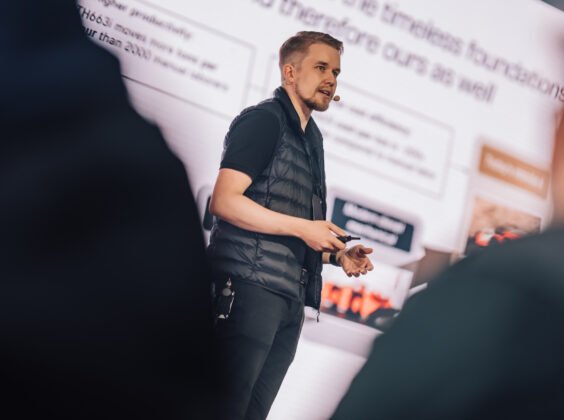
“This is one of the key reasons why we believe in electrification,” Valkonen (pictured below) said of these examples.
And, in certain cases – especially those with a ventilation constraint – the fact BEVs produce 80% less waste heat and come with no local diesel emissions already brings the total cost of ownership (TCO) down below the diesel baseline, according to Valkonen, in line with that Toro standard. Sandvik has estimated an 84% lower energy cost for the use of BEVs at Lamaque, for instance, as part of an ongoing business case evaluation.
“With these two factors combined, we can no longer look away from the fact that we have the absolute best tool for the job for certain applications with our BEVs on both a productivity and TCO basis,” he added.
Cost, support and portfolio
Still, Sandvik believes it can do more to ensure the benefits are felt earlier in the BEV deployment process. It also thinks the TCO equation between diesel and BEVs can improve further.
Valkonen explained: “We will recognise immediately that, yes, BEVs currently cost too much for our comfort, and we need to work on that to make the TCO more palatable for more of you.”
He said the development of Sandvik’s own diesel-electric line of load and haul machines would help here, as would the continued expansion of BEV production in other industries outside of mining.
“There will be more scaling, more economies of scale in the supply chain that will benefit that TCO,” he said.
And new and existing deployments will benefit from more “structured training” as well as a pledge of getting closer to customers to increase machine availability by providing systematic troubleshooting of every issue, from start-up through to steady-state operation.
Valkonen said the company is looking to address parts availability too, with Sandvik engineering teams’ ability to schedule planned maintenance intervals improving as the current crop of BEVs clock up hours on their way to mid-life or end-of-life milestones.
Refining the product portfolio will help the company achieve these aims, the OEM claimed.
Currently, there is only one of Sandvik’s commercial BEV fleet with a Toro precursor in front of it – the Toro LH518iB – but there are expectations the TH550B will join that club soon (possibly with a i-series retrofit option). The pre-commercial Toro LH411iB – showcased in Turku – will likely be the third BEV that comes under this platform, while the 600 series diesel-electric truck and loader are also being lined up for incorporation into this exclusive club.
Already knowing the benefits BEVs bring to ventilation-constrained operations, Sandvik will also be clearer in how it engages with customers, with Valkonen admitting this could result in the company turning away business – “if we don’t believe that a BEV installation will make money for you based on our projections, we may ask you to wait a bit until it will”.
Artisan alignment
Acknowledgement of this revised strategy comes as the wider mining company ecosystem has cooled its jets on pursuing electrification of mobile fleets. This is tied to the reduced weighting it places on decarbonisation and sustainability compared with, say, three years ago.
The fallout from this readjustment of priorities will be felt towards the end of the decade when interim emission reduction goals are either revised or pushed back. Mining companies are already laying the groundwork for this, highlighting a lack of ‘commercial’ options when it comes to explaining the potential use of fully-electric equipment in their annual sustainability reports.
This reprioritisation of priorities isn’t all bad news for OEMs, according to Valkonen.
“In some sense, the issue in selling BEVs in the past has been the difficulty of quantifying what the monetary value of sustainability actually is,” he told IM. “The metric has been tried every which way in in my opinion – for all the right reasons – but we now have to accept that we should take a different approach.”
Sandvik, by leveraging the productivity and TCO benefits that are associated with the Toro name, is intent on re-energising the BEV discussion.
And it isn’t just its Toro roots being revisited as part of this new strategy.
Artisan Vehicle Systems, the company that Sandvik acquired in 2019 to accelerate its BEV push, was originally engaged by mining companies to design electric vehicles that could lower their operating costs through a reduction in ventilation requirements. Its mission, ‘To Make Vehicles That Change The World,’ was no different to what Sandvik is trying to do now.
Valkonen added: “Artisan’s core message was around productivity, because at that point – without the sustainability catalyst – if the battery-electric machine it was developing wasn’t more productive than what was there before, there was no point in building it.”
The post Sandvik striving for Toro standard as part of new electrification strategy appeared first on International Mining.


